
Earlier this week, Andrew Hacker, a political science professor at Queens College, City University of New York, opined in an essay for the New York Times that high schools should stop teaching higher Algebra concepts — because kids don’t get it.
I’m sure Mr. Hacker isn’t alone in his frustration with the failure rates of students in these courses. (Trust me, math teachers are pulling their hair out, too.) Yes, math is hard. And it’s also the underpinning of our physical world. By pretending it doesn’t matter or that our future engineers, teachers, nurses, bakers and car mechanics don’t need it one eensy-teensy bit, we risk the dumbing down of our culture. And our students risk losing out on the highest-paying careers and opportunities.
The problem isn’t the math — as Mr. Hacker eventually mentions, though obliquely. It’s how the math is taught. We need to get a handle on why students feel so lost and confused. And here are just two reasons for this.
1. Kids don’t know what they want to be when they grow up — especially girls who end up in math or science fields.
When I was in seventh grade, I thought I was a horrible math student. I was beaten down and frustrated. I felt stupid and turned around. Unlike my peers, I took pre-algebra in eighth grade, effectively determining the math courses I would take throughout high school. (I wasn’t able to take Calculus before graduating.)
And that was a fine thing for me to do. Turns out I wasn’t stupid or bad at math. I just had a poor understanding of what it meant to be good at math. I had really talented math teachers throughout high school. I was inspired and challenged and encouraged. By the time I was a senior, it was too late to take Calculus, so instead I doubled up with two math courses that year.
After graduation, I enrolled in a terrific state school and became a math major. Four years later, I graduated with a degree in math education and a certification to teach high school. And now, 22 years later, my job revolves around convincing people that math is not the enemy.
What if I had been told that algebra didn’t matter? What if I had been shepherded into a more basic math course or track? Because higher level math courses were expected of me — and because I had excellent math teachers — I found my way to a career that I love. Even better, I feel like I make a difference.
How many other engineers, scientists, teachers, statisticians and more have had similar experiences? How many of us are doing what we thought we wanted to do when we were 12 years old? Why close the door to discovering where our talents are? To me, that’s not what education is all about.
Look, I can’t say this enough: I was an ordinary girl with an ordinary brain. I can do math because I convinced myself that it was important enough to take on the challenge. I was no different than most students out there today. We grownups need to figure out ways to hook our kids into math topics. I’m living proof that this works.
2. Higher algebra concepts describe how our world works.
How does a curveball trick the batter? How much money can you expect to have in your investment account after three years? What is compound interest?
Students need to better understand the math in their own worlds. We do them a grave disservice when we give them problem after problem that merely asks them to practice solving for x. The variable matters when the problem is applied to something important — a mortgage, a grocery bill, the weather, a challenging soccer play.
We can’t pretend that everyone depends on higher-level mathematics in their everyday lives. But neither can we pretend that these concepts are immaterial. Knowing some basics about algebra is critical to being able to manage our money or really get into a sports game.
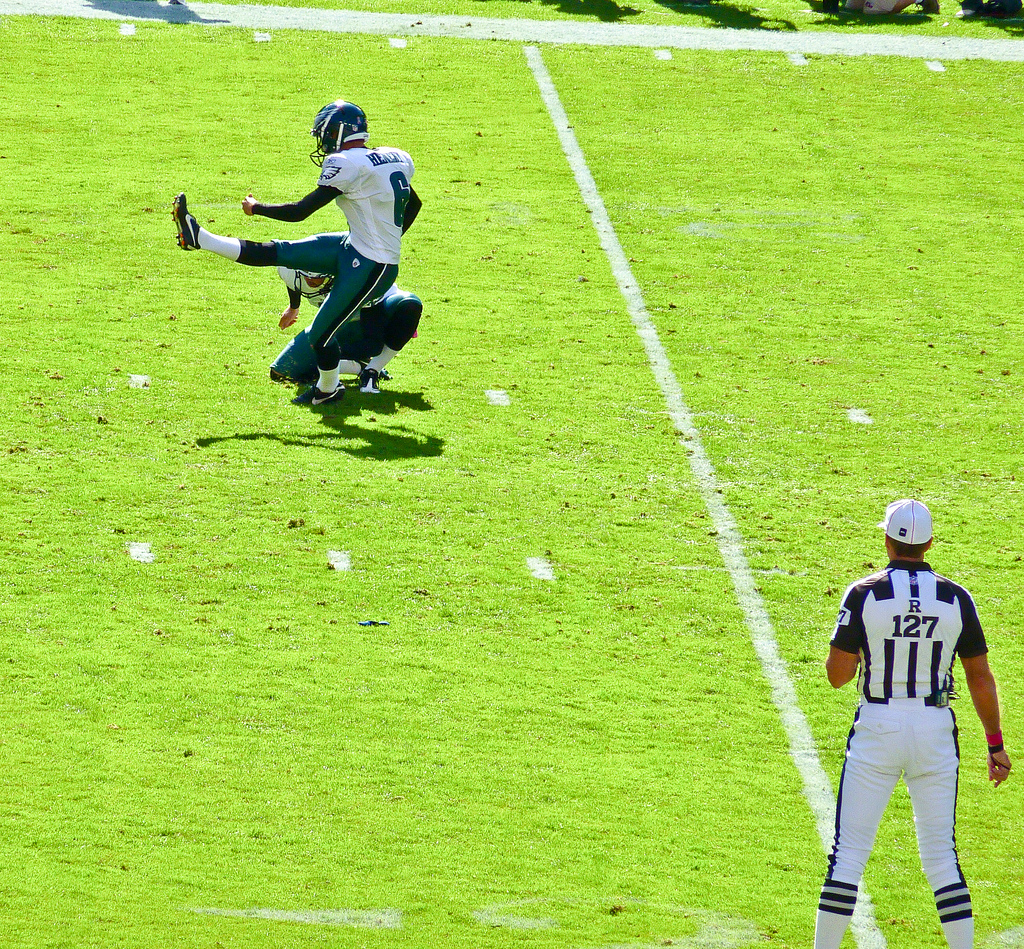
For example, when the kicker attempts a field goal in an American football game, he is depending on conic sections — specifically parabolas. Does he need to solve an equation that determines the best place for his toes to meet the ball in order to score? Nope. But is it important for him to know that the path of the ball will be a curve, and that the lowest points will be at the points where he makes contact with the ball and where the ball hits the ground.
That’s upper-level algebra at work. If you were to put the path of the football on a graph, making the ground the x-axis, those two points are where the curve crosses or meets that axis.
What’s so hard about that?
Look, we need to adjust the ways we teach math and assess math teachers. I agree that math test scores aren’t the be all, end all. I agree that most high school students won’t be expected to use the quadratic formula outside of their alma mater. (Though algebra sure is useful with spreadsheets!) And I agree that asking teachers to merely teach the concepts — without appealing to students’ understanding of how these concepts apply to their everyday lives — is draining the life out of education.
And really, how much of the rest of our educational system is directly useful? Do I need to spout out the 13 causes of the Civil War or balance a chemical equation or recite MacBeth’s monologue? (“Tomorrow, and tomorrow, and tomorrow, Creeps in this petty pace from day to day…”) I can say with no hesitation: Nope! But learning those facts helped inform my understanding of the world. Algebra is no different.
What do you think about the New York Times piece? Do you agree that we should drop algebra as a required course? In your opinion, what could schools do differently to help students understand or apply algebra better?





I agree completely with you. I believe that the current standards are partially to blame because they do not adequately prepare students for the challenges of algebra. The Common Core State Standards will begin to address this issue when they are fully implemented in 2014. However, without radical shifts in teacher preparation and attitudes towards math, it will take much longer for these changes to become apparent.
Relatively few people write thesis-driven essays on a daily basis, and those are similarly hard tasks that we expect from high school students. However, nobody says that we should stop requiring writing such essays. The purpose of the exercise is not about the specific knowledge gained or argued in the paper, but about learning the skill of how to develop and express a logical and well-crafted argument. The same is true for algebra, when it is taught correctly.
The big shift in 21st century education is that school is now less about specific knowledge and more about knowing how to learn, how to solve new and innovative problems, and how to craft and evaluate arguments. Algebra acts as a gatekeeper in this regard because it demonstrates mastery of these skills. While the quadratic formula may fade from memory, the enduring understanding is that there exist equations that may have 0, 1, or 2 solutions and where one or more of these solutions may not be real-world relevant.
Arithmetic is useful in daily life to help solve the 1 problem in front of you, but algebra helps you solve an infinite number of these problems simultaneously.
- Julien Colvin
Math Teacher
“While the quadratic formula may fade from memory, the enduring understanding is that there exist equations that may have 0, 1, or 2 solutions and where one or more of these solutions may not be real-world relevant.”
EXACTLY! And that’s where I think math teachers (and education administrators) should adjust their expectations. I’m developing a post right now that goes into this in more detail. We need to tease out the conceptual ideas from the calculation skills. I’ve said many times that I want students (and adults) to remember that a quadratic equation is a curve, while a linear equation is a line. Remembering this is infinitely more useful (conceptually) than memorizing the quadratic formula.
And believe it or not, parents can help with this. Stay tuned for more details… (And thanks so much for posting!)
Laura
Laura recently posted..Algebra: Is It Too Hard for Students?
I think it would also help if we can show times we actually used algebra in daily life. Especially outside of our jobs. My own example is comparing two DVD box sets on eBay, figuring out which was the better value for my budget- after shipping was taken into account.
I think I get it now, but it was always rather abstract to think of an equation as a line or curve- but then again math has always seemed rather a foreign language to me. Weirdly, crochet and music have made it more real to me. Perhaps I needed a cross-discipline study?
You are completely right — math courses need to depend more on application. Think about when you were a teen. Did you care what x was? Would it have been more interesting if it could be used to determine whether a person was at fault in a car accident? Too often we treat math and real-life as mutually exclusive entities. When we do use applications, they are often far beyond students’ actual interests. It’s not easy to offer these applications — especially given the current climate in education, emphasizing rote memorization and algorithms — but it’s critical. I’m hopeful that Julien Colvin is right — that Common Core will offer teachers the opportunities to do what they do best: teach critical thinking and inspire students to explore.
Laura
And here I thought I was doing better, when today I wanted to explain the distributive property (which I’ve always had issues with) to my son. I went to wikipedia hoping to get an overview, and… “In abstract algebra and logic, distributivity is a property of binary operations that generalizes the distributive law from elementary algebra. In propositional logic, distribution refers to two valid rules of replacement. The rules allow one to reformulate conjunctions and disjunctions within logical proofs.”
…yeah. I get about half of it on a third reading, and not enough to explain it to my son. I assume there are websites that would help, the issue is finding them when I need them.
Oh that’s so frustrating! In times like these, I like to think about the language rather than the math. What does “distribute” mean? See if you can come up with a situation (like “distributing” M & Ms among friends or what ever topic really gets his juices flowing) that will illustrate what is happening mathematically.
Then see if you can demonstrate *why* the distributive property works. Show what happens when you don’t distribute (do the math wrong).
As for online algebra resources, I really love Purple Math: http://www.purplemath.com/modules/index.htm. In fact, here’s a link to their explanation of the distributive property: http://www.purplemath.com/modules/numbprop.htm. I find this site really helpful, when I’ve forgotten a detail or need to be sure that I’m remembering something correctly. (I don’t teach math everyday, and like anyone I get rusty!)
Hope that helps… I’ll work up a post that addresses this more specifically.
Laura
Laura recently posted..Algebra: Is It Too Hard for Students?
About the three examples of applications you give:
1) The curveball—I am not sure how you would do this with algebra. Doesn’t it involve physics and calculus?
2) Compound interest rate is a classical application, found in ALL algebra textbooks, I guess.
3) How does knowing that the curve is a parabola help catching the ball?
I know, good applications are so important, but they don’t come easy to the teacher. Many real world applications are too complicated. Many more are too tedious—doable, but taking care of all details would require hours. And most require some other knowledge, facts about the world, that takes a lot of time to acquire.
The same for applying math in real world. Hacker states that most people rarely apply algebra later in their lifes. True, but the reason is that life doesn’t ask you to solve a system of two equations, you have to decide when you try to model a given situation. There are always different ways to model, almost always neglecting details of the situation, which you think to be irrelevant. (BTW, this modeling is also rarely taught in schools and even colleges.) And finally, even simple everyday problems often require advanced math, often a combination of methods of different areas. I do this a lot in my life, but it is not obvious at all.
Great response. Thanks so much. I agree that good applications don’t always come easily to a teacher. But I also believe that when kids truly see that math is applicable, they have a better appreciation for it — and might even feel more motivated to work harder at it. Time and time again, I hear from students who tell me that they don’t like math because it’s pointless. When I was teaching, it was my job to help my kids see the reasons they were learning something. As for your specific points:
1. Curveball: sure, physics and calculus play a role in how a baseball is pitched. But at its very, very base, so does algebra. (Algebra is he foundation of physics and calculus — you simply cannot do either of these without algebra.) Algebraic equations (quadratic equations in particular) define the curve of the path of the ball. I’m not saying that a pitcher necessarily understands that. I am saying that kids can use that curveball to apply some of the algebra that they are learning. But yes, somewhere, someone has outlined the algebra involved in a curveball. And I’m betting the results could help a pitcher.
2. Compound interest: Yes is it is a classic application, and one that many, many adults don’t understand. It is the No. 1 question I get from adults when they find out about my book. And the biggest problem they have is that they don’t understand that compound interest can be described as a curve, while simple interest is linear. That very tiny bit of information can uncover a great world of understanding about how their money can be managed, yes?
3. Parabolas and footballs: The height and length of the parabola define its starting and ending points. If the ball falls short of its goal, the kicker has sent it into the air too high, for example. Again, this is not something that the kicker is necessarily going to work out on paper before he runs onto the field, but it is part of his job, right? And a kicker’s coach is going to know a little bit about this — at least from a general perspective.
Again, I’m not suggesting that we should all leave high school algebra with an intimate understanding of conic sections or how to find the roots of all quadratic equations. I am saying that through a good, rigorous algebra course, a student will add to his mathematical instincts, offering him a much better understanding of the world around him and the ability to solve problems that he faces in his everyday life (or at least be able to look them up). You are very right that everyday life often requires advanced mathematics. I think it’s fine that people don’t notice that they’re doing this math. It means it’s become an integral part of their day!
Thanks again for responding!
Laura
Oh and one more thing — as if I haven’t said enough already!
One part of my work is developing curriculum for middle and high school math courses (typically online courses). In a unit about conic sections (which is typically the first unit of an algebra II course), I began with a soccer problem — which person kicked the ball the farthest? By the end of the lesson, the students could apply what they learned about parabolas to solve the problem. Yes, it was a bit contrived, but it did do exactly what I’m suggesting here: demonstrate that these concepts are the underpinning of our world.
In case it wasn’t clear, I’m not suggesting that a solid understanding of these ideas is critical for all soccer, football or baseball/softball players. I am saying that the basics of these concepts can be shown in these settings — and that’s sometimes all students need to feel more motivated. Why not actually replicate this problem in the classroom using small groups? Ask students to predict the outcome and then test their hypothesis using math. (And yes, I understand that the current educational climate doesn’t usually allow for this. That’s sad.)
Laura